
(Grace)
The skipper beat me to posting about this leg of our trip (which was not hard as I am still recuperating brain cells and repairing my relationship with word processors after writing my thesis) but there are still some things I’d like to say about Alert Bay. I was eager to visit the U’mista Cultural Centre to learn more about the history and culture of the area, but, as Jim mentioned in his last log entry, it was closed during our visit due to a scheduled power outage. This is the second misfortune in what I hope will not become a string of bad luck with museums; I was also unable to visit the Museum of Anthropology at UBC in Vancouver because it was undergoing, of all things, seismic upgrades.
Unexpected yet premeditated power outage aside, there was still a lot to learn from Alert Bay itself, especially when supplemented with a little bit of Googling. The bay — along with most of the water and land on either side of the Inside Passage from Discovery Passage in the southeast to the Queen Charlotte Sound in the northwest — is territory of the Kwakwakaʼwakw people. Like many of the First Nations, the Kwakwakaʼwakw never ceded their land, not to the early British colonizers and not to the current Canadian occupiers. Despite this, you will unfortunately find their land absorbed into Canada’s borders on a map as their sovereignty is not recognized.
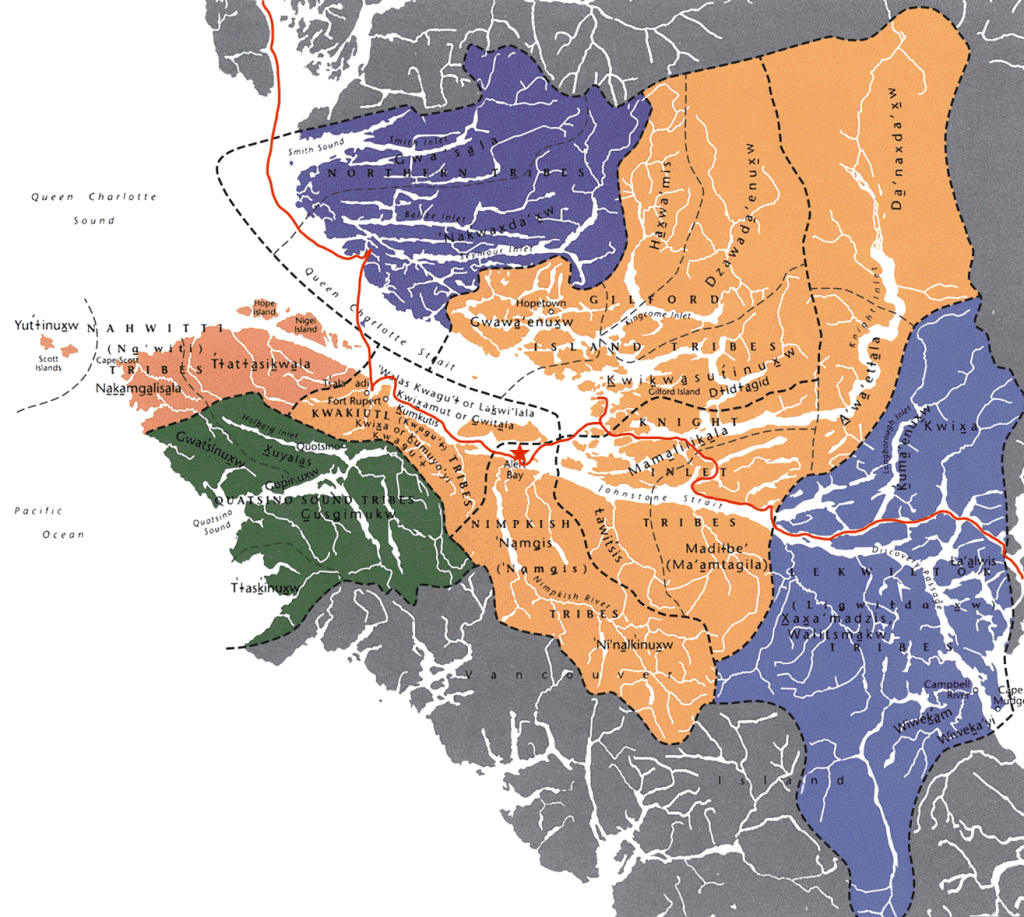
The Kwakwakaʼwakw are an ethnolinguistic group united by their common language (Kwak’wala) but comprised of eighteen politically-distinct nations. One such nation is the ʼNamgis nation, which holds claim to Alert Bay and the surrounding region.
As you might have guessed, the Germanic cluster of phonemes that is “Alert Bay” was not the original name for the area. The Kwakwakaʼwakw knew it as ‘Yalis, a name that survives in the ʼNamgis village of Yalis, which shares Cormorant Island with Alert Bay. Traditionally, the Kwakwakaʼwakw were a marine foraging culture — meaning they subsisted by hunting and gathering at land and sea — and ‘Yalis was an important site for harvesting food and other resources. Although the Kwakwakaʼwakw are no longer traditional marine foragers, fishing and crabbing still seems to be important to the people of Alert Bay judging by the fishing boats and crab pots we saw near the bay.
Many other parts of their culture have persisted to today as well, most notably totem poles. Alert Bay is home to many totem poles, including the world’s tallest totem pole!
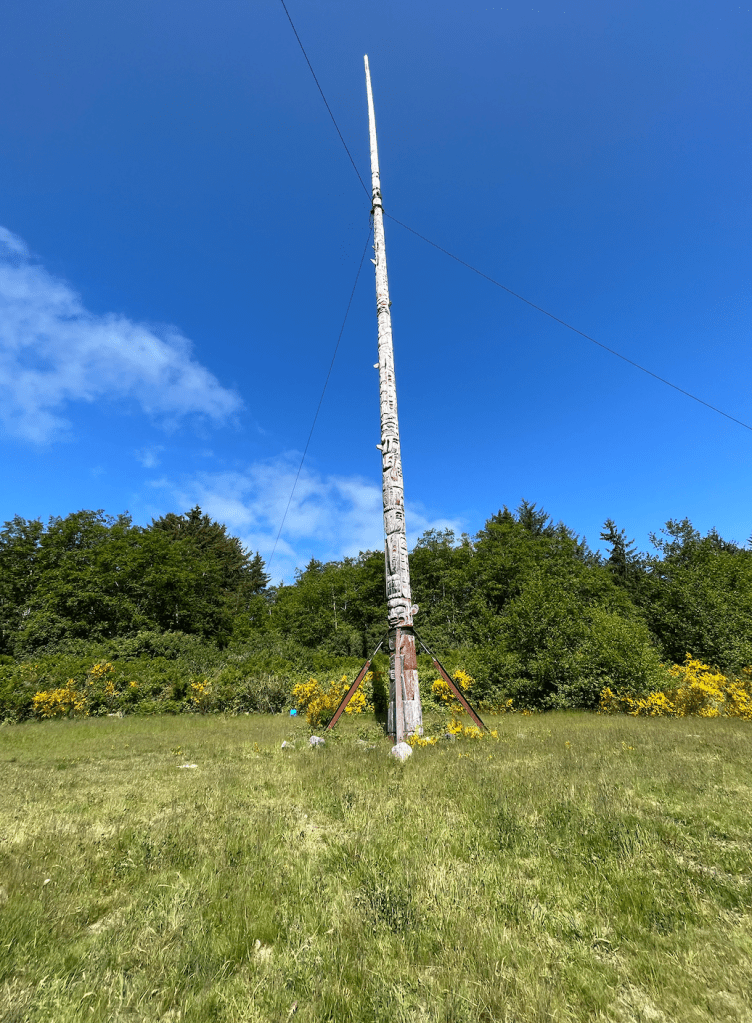
“This is not the first “world’s tallest totem pole” I’ve seen,” says Melinda.
“As if,” says I.
Well, hell. The internet agrees with my mom. There are several totem poles in a vicious fight over who gets to say that they are the world’s tallest. Alert Bay’s totem pole stands at 173 feet tall, which does, in fact, make it the tallest. But that’s only if height is all you care about. If you want to get finicky about it, you might claim that totem poles have to be carved of only one section of wood, and therefore the world’s tallest totem pole is in McKinleyville, California. You might also argue that totem poles have to be free-standing, so the world’s tallest is in Victoria, B.C. Personally, I have to side with Alert Bay; even if you only count its 163 foot tall lower section, the Alert Bay totem pole still stands taller than McKinleyville’s measly 159.5 foot pole.
Totem pole discourse aside, Alert Bay also gave us space to learn about two of the more tragic chapters in the story of the indigenous peoples of North America. The U’mista Cultural Centre stands next to the former grounds of St. Michael’s Indian Residential School, one of 139 residential schools across Canada that served to tear children away from their families and strip them of their culture.
St. Michael’s was established as an Anglican mission in the late 19th century and stood in operation until the late 1970s. Hundreds of First Nations children, mostly Kwakwakaʼwakw and Haida, were coerced into attending the boarding school. Miles away from their families and communities, the children were completely vulnerable to the power of the institution and its staff that sought to “civilize” (i.e. ethnically cleanse) them. They describe being routinely dehumanized, humiliated, neglected, deprived of food and water, and forced into doing dangerous labor. Physical and sexual abuse were also exceedingly common. Punishment and abuse were often explicitly linked to the correction of “uncivilized” (i.e. non-European, unchristian, or simply childlike) behavior, especially the usage of native languages, which was strictly forbidden.
Residential schools like St. Michael’s were one of the most effective cogs in the colonial machine of cultural genocide. This is not to say that the goal of these schools was to kill children, although at least fifteen children died while attending St. Michael’s. The goal was to kill the people by killing their culture, and many residential schools came close to succeeding in this goal. When the youngest generation is severed from their elders and forbidden from speaking their language, many critical components of culture cannot be transmitted and are subsequently lost. This is especially lethal to cultures that pass on so much of their knowledge through oral tradition, as is the case in most of North America. The Kwak’wala language was almost entirely lost as a near direct result of St. Michael’s. Although there are active efforts to rehabilitate the language, much of the damage cannot be easily repaired.
St. Michael’s was ceremonially demolished in 2015 and today the only thing that occupies the former site is a memorial to the children of the school.
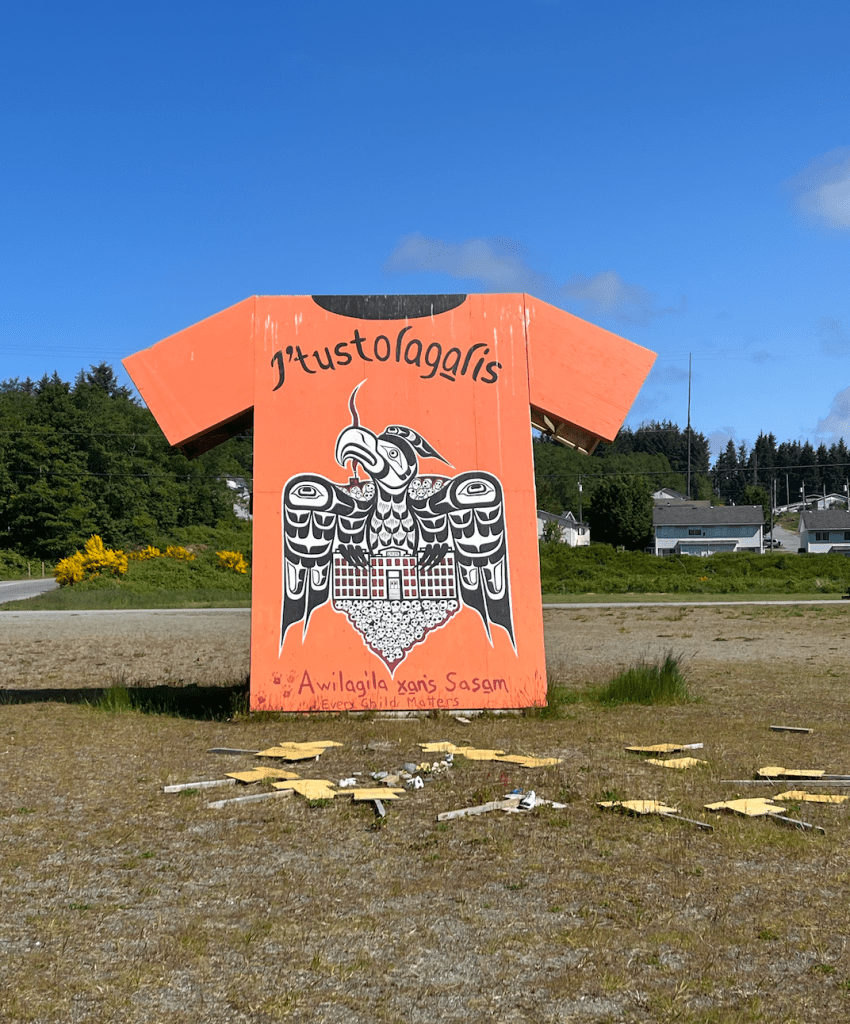
The memorial reads “I’tusltolagalis / Awilagila xan’s Sasam” meaning “rising up together / every child matters.” The orange T-shirt is the symbol of the National Day for Truth and Reconciliation (also known as Orange Shirt Day), which calls us to remember the suffering of residential school students.
An orange shirt might seem a shockingly modern symbol, but that’s because residential schools are shockingly modern; most residential schools were in operation near the end of the 20th century and the last Canadian residential school was closed in 1998. The orange T-shirt was inspired by the experiences of Phyllis Webstad, a girl from the Stswecem’c Xgat’tem First Nation sent to St. Joseph’s Mission, a residential school at Williams Lake. She recounts that:
“We never had very much money, but somehow my granny managed to buy me a new outfit to go to the Mission school. I remember going to Robinson’s store and picking out a shiny orange shirt. It had string laced up in front, and was so bright and exciting – just like I felt to be going to school!
When I got to the Mission, they stripped me, and took away my clothes, including the orange shirt! I never wore it again. I didn’t understand why they wouldn’t give it back to me, it was mine! The color orange has always reminded me of that and how my feelings didn’t matter, how no one cared and how I felt like I was worth nothing. All of us little children were crying and no one cared.
Phyllis Webstad
Today, Webstad is only 56, and there are many her age or younger that were sent to residential schools in their youth. The trauma of residential schools are very much still in living memory.
The second memorial we saw in Alert Bay was a sign reading “No More Stolen Sisters.” In the tree next to the sign hung two red dresses.
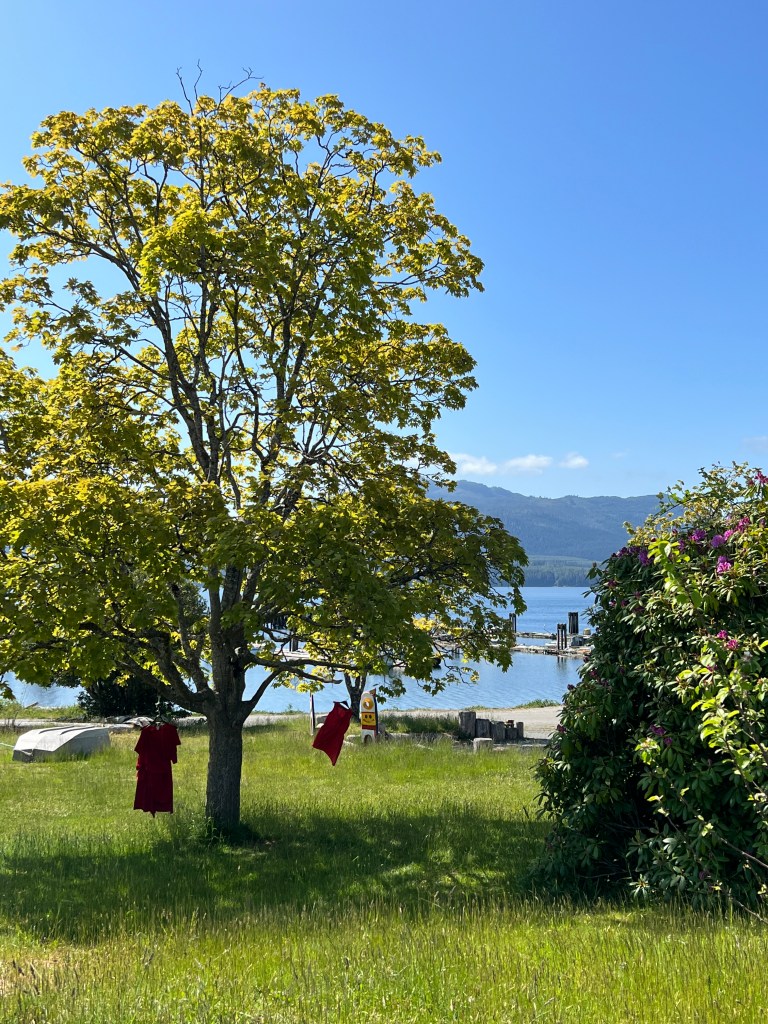
Like the orange T-shirt, these red dresses are evocative of a larger social movement. The use of the symbol started in 2010 when artist Jamie Black started a project called REDress to bring attention to the extreme rates of violence against indigenous women. The disembodied dresses force you to see the absence of the women who are no longer here as a result of such violence.
The statistics on violence against indigenous women in Canada and the United States are staggering. More than 63% of Canadian indigenous women and 84% of American indigenous women have experienced violence such as physical or sexual assault in their lifetimes. The majority of this violence is perpetrated by non-indigenous men. In the United States, this is especially critical because indigenous tribes almost never have the jurisdiction to prosecute non-indigenous offenders. This means indigenous women are exceptionally vulnerable to violence from outsiders, who essentially have criminal impunity.
These conditions for violence translate to shockingly disproportionate numbers of missing and murdered indigenous women. In the United States, indigenous women face murder rates ten times higher than the national average in many tribal lands. Murder is the fourth leading cause of death for indigenous girls under the age of 19 and sixth for indigenous women under 44. Despite the prevalence of deadly violence, the government rarely takes reported cases of missing indigenous women seriously. As of 2016, NamUS, the Department of Justice’s missing persons database, had logged only 116 cases of missing indigenous women when nearly 6,000 had been reported, which is less than 2%. The numbers in Canada aren’t much different.
Both the orange T-shirt and the red dress call on us to recognize the damage done to indigenous communities by historical and contemporary colonial violence. In either item of clothing we can see a space a person was meant to inhabit left vacant. Yet despite these empty spaces, indigenous communities all over the continent have proven themselves resilient and persistent. The Kwakwakaʼwakw and its eighteen nations are still here in Alert Bay, throughout the Inside Passage, and all over North America.
 Sailing Perception
One response to “May 28th, 2023: More on Alert Bay”
Interesting and sad history but thanks for sharing.
LikeLike