
During the course of our trip to Ketchikan, I kept a log of the distance as the crow flies between each stop and Ketchikan. I then plotted this across the different stoping point each day.
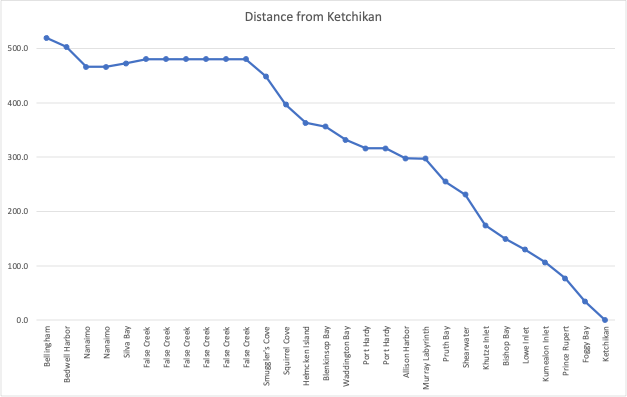
We got off to a pretty rapid start, and had covered more than 10% of the distance to Ketchikan in the first two days. We then slid backwards as we went across the Strait of Georgia to Vancouver, and stayed there for almost a week.
After leaving Vancouver our progress was relatively rapid. It slowed down as we hit the Johnstone Strait, and wound our way up to the Broughtons and over to Port Hardy. Once around Cape Caution we were off to the races again, with some mile-eating days going through the inside passage.
Some other statistics:
- Total days from Bellingham to Ketchikan: 28 days
- Days underway from Bellingham to Ketchikan: 21 days
- Average rate of closure on Ketchikan (all days): 18.5 nm/day
- Average rate of closure on Ketchikan (underway): 24.7 nm/day
- Average distance covered per day (underway): 36.6 nm
- Total distance covered (approximate): 769.4
- Gallons of diesel fuel consumed: 234.4
- Fuel efficiency: 3.28 nm/gallon
Note that our progress to Ketchikan was almost completely under engine power, other than a few rare instances when we made way under sail or motor sailing. When motoring, early in the trip we would run with a single engine at times to conserve fuel, as we can get 70-80% of full speed with just a single engine. We also ran at lower engine speeds at times when we weren’t itching to get in to the next harbor.
All and all, we found that the wind was on our nose nearly all the time, especially early in the trip. I don’t have good excuses for not raising the sails more often other than trying to maximize the distance covered each day. We have been in too much of a hurry! Hopefully we can slow down a bit on the way south…
 Sailing Perception